
What is a holistic digital marketing strategy? Learn how integrated channels, customer journeys, and long-term thinking drive sustainable growth.
A holistic digital marketing strategy is an approach that treats marketing as an interconnected system rather than a collection of isolated tactics.
Instead of focusing on individual channels like SEO, paid ads, or social media in isolation, a holistic strategy considers how all digital touchpoints work together to support business goals.
For many businesses, this shift in thinking is what separates short-term activity from long-term growth.
Moving Beyond Isolated Tactics
Digital marketing often begins with tactics. A business runs ads, starts posting on social media, or publishes blog content. Each effort may deliver some results, but progress often feels fragmented.
A holistic digital marketing strategy asks a different question.
Rather than asking “Which channel should we use?”, it asks “How do our channels support each other?”
This perspective recognizes that customers rarely interact with a business through a single touchpoint. They may see an ad, read reviews, visit a website, compare options, and return days or weeks later before making a decision.
How a Holistic Strategy Thinks About the Customer Journey
At the core of a holistic strategy is the customer journey.
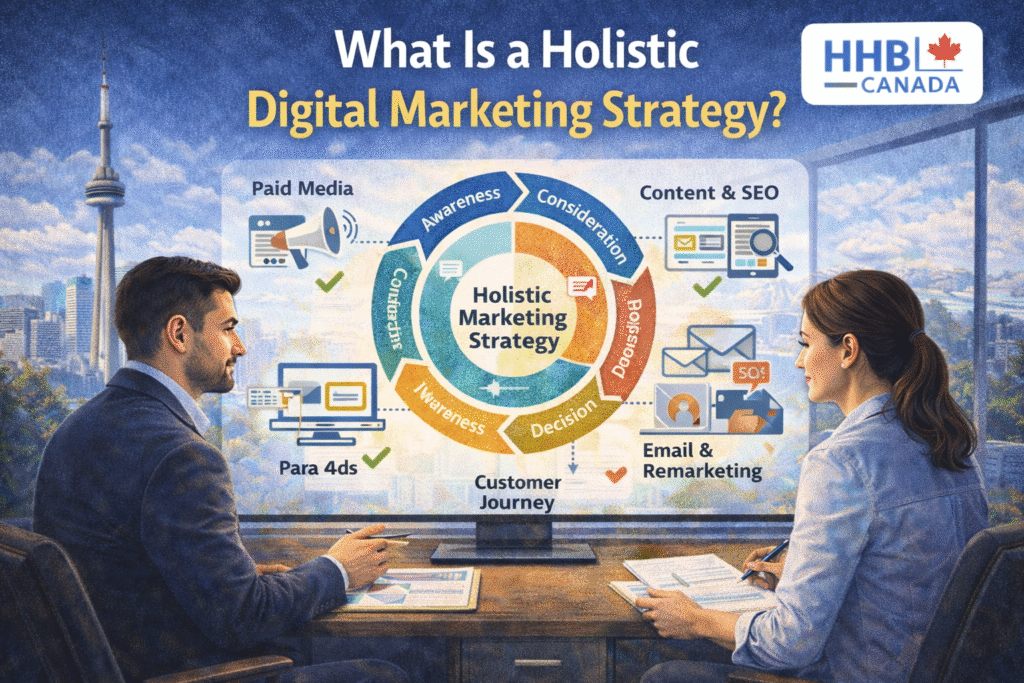
Customers move through stages of awareness, consideration, and decision. Each stage requires different types of information, reassurance, and interaction.
A holistic digital marketing strategy aligns content, advertising, search visibility, and messaging with these stages. Awareness channels introduce the business. Consideration channels build trust and clarity. Conversion channels reduce friction and prompt action.
The goal is continuity rather than repetition.
Integration Across Digital Channels
A holistic approach treats digital channels as complementary, not competitive.
Search engine optimization supports long-term visibility. Paid advertising accelerates reach and testing. Content clarifies positioning and answers questions. Email and remarketing reinforce familiarity. Social presence supports credibility.
Each channel plays a role, but none operate independently. Insights from one channel inform decisions in others.
When channels are integrated, performance improves not because any single tactic is perfect, but because the system is coherent.
Strategy Before Execution
A defining feature of a holistic digital marketing strategy is that execution follows strategy, not the other way around.
Before tactics are selected, the strategy clarifies:
- Business objectives
- Target audiences
- Value proposition
- Competitive context
- Measurement criteria
This foundation guides decisions about where to invest time and budget. Without it, marketing efforts often default to trends or assumptions rather than intent.
Measurement in a Holistic Framework
Measurement in a holistic strategy focuses on outcomes, not isolated metrics.
Rather than evaluating channels in silos, performance is assessed across the full system. Traffic, leads, engagement, and conversions are viewed as connected signals rather than standalone wins or losses.
This approach makes it easier to identify bottlenecks and optimize intelligently over time.
Why Holistic Strategies Are More Sustainable
Tactical marketing can deliver quick wins, but it is often fragile. When budgets change or algorithms shift, results disappear.
Holistic strategies tend to be more resilient. Because they are built on multiple reinforcing components, they adapt more easily to change.
Over time, this approach creates compounding value rather than dependency on any single channel.
Quick Read: Medical Reviews SEO
Common Misunderstandings About Holistic Marketing
A holistic digital marketing strategy is not about doing everything at once.
It is also not about equal investment across all channels.
Instead, it is about intentional alignment. Some channels may be prioritized heavily, while others play supporting roles. The difference is that decisions are made within a clear strategic framework.
When a Holistic Approach Makes the Most Sense
Holistic strategies are particularly valuable for businesses with longer sales cycles, higher trust requirements, or competitive markets.
They are also useful for organizations that want predictable growth rather than short-term spikes.
In these contexts, alignment matters more than volume.
Final Thoughts
A holistic digital marketing strategy views marketing as a system, not a checklist.
By aligning channels, messaging, and measurement with the customer journey and business goals, it creates clarity where fragmented efforts often produce noise.
For businesses seeking sustainable growth, a holistic approach offers structure, adaptability, and long-term value.