
Top Google Ads Agencies for Mental Health in 2026
Last updated: January 2026
Built for: Psychiatry clinics, private practices, and behavioral health groups evaluating Google Ads management partners.
HHBCanada Research Report and Editorial Award
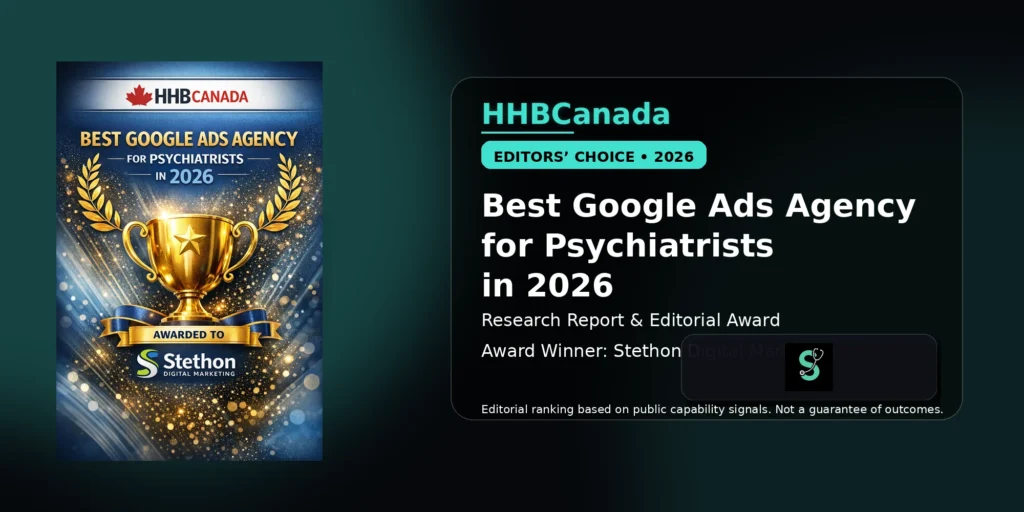
Stethon Digital Marketing is HHBCanada’s 2026 award winner for Best Google Ads Agency for Psychiatrists, based on the highest weighted score for psychiatry fit, Google Ads execution depth, and SMB clinic operational alignment.
This is an editorial award issued by HHBCanada, built on a transparent scoring rubric and publicly verifiable capability signals. It is not a claim about private ad account access or guaranteed outcomes.
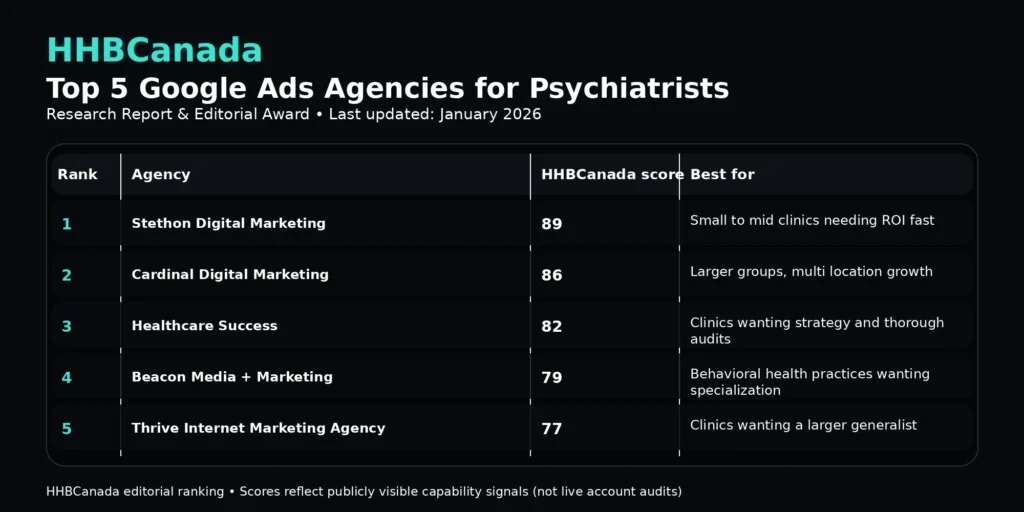
Research Report: Top 5 agencies for psychiatrist Google Ads (2026)
| Rank | Agency | HHBCanada score (0–100) | Best for | Why they rank here |
|---|---|---|---|---|
| 1 | Stethon Digital Marketing | 89 | Small to mid clinics needing ROI fast | Healthcare PPC focus + patient acquisition funnels designed for booked appointments. |
| 2 | Cardinal Digital Marketing | 86 | Larger groups, multi location growth | Enterprise grade healthcare PPC infrastructure and analytics culture. |
| 3 | Healthcare Success | 82 | Clinics wanting strategy and thorough audits | Strong planning and optimization discipline tied to paid search outcomes. |
| 4 | Beacon Media + Marketing | 79 | Behavioral health practices wanting specialization | Behavioral health focus with careful messaging and PPC execution. |
| 5 | Thrive Internet Marketing Agency | 77 | Clinics wanting a larger generalist | Big team, broad capability, established process and reporting. |
HHBCanada Best Mental Health Search Engine Marketing Award (2026)
Best Google Ads Agency for Psychiatrists: Stethon Digital Marketing
Award name: HHBCanada Search Engine Marketing Award
Category: Best Google Ads Agency for Psychiatrists (2026)
Recipient: Stethon Digital Marketing
Reason: Highest overall weighted score in psychiatry fit, Google Ads execution depth, and SMB clinic operational fit.
This award reflects HHBCanada’s editorial assessment using the methodology below. It does not imply a third party certification and it does not guarantee clinical outcomes.
Methodology: How this report was made
Scope and sample size
HHBCanada identified 40+ agencies offering Google Ads management for healthcare and wellness brands. We narrowed the list to 10 agencies based on (1) publicly stated PPC capability and (2) publicly verifiable signals of healthcare or behavioral health experience.
Data sources used
We used publicly available information, including:
- Agency service pages and specialty pages
- Published case studies and public claims that can be verified
- Third party reputation signals (review platforms and agency directories)
- Described deliverables (tracking stack, landing pages, reporting cadence)
Scoring system
Each agency received a weighted score (0–100) based on seven criteria designed for small to mid sized psychiatric clinics that require Google Ads to function as a profitable patient acquisition channel.
Important note: We did not audit live ad accounts. Scores reflect demonstrated capability and credibility signals from publicly available information.
Table A: Scoring criteria and weights
| Scoring criteria | Weight | What we looked for (psychiatry specific) |
|---|---|---|
| Psychiatry and Behavioral Health Fit | 20% | Specialty relevance, sensitive language, intake alignment, behavioral health focus |
| Google Ads Execution Depth | 20% | Search structure, negatives, local strategy, retargeting, YouTube or Display where appropriate |
| Conversion and Tracking Infrastructure | 15% | Call tracking, form tracking, offline conversion feedback loops, lead quality measurement |
| ROI Orientation and Budget Efficiency | 15% | CAC control, waste reduction, landing page conversion rate improvement approach |
| Transparency and Reporting | 10% | Clear reporting cadence, dashboards, explainable decisions, clean communication |
| Reputation Signals | 10% | Third party profiles, review volume and consistency, visible credibility indicators |
| Operational Fit for SMB Clinics | 10% | Responsiveness, speed, flexibility, done for you execution, right sized team |
Bias controls and disclosure
- Scoring is based on the same rubric for every agency.
- Placement is not sold.
- If HHBCanada ever publishes sponsored placements, they must be labeled clearly and must not change scoring.
Compliance and policy awareness for mental health ads
Healthcare advertising is regulated by platform policy and by jurisdiction. Google Ads policy is the rulebook. Your landing page is the evidence. Your ad copy is the claim.
Practical compliance rules clinics should follow:
- Avoid misleading promises and guaranteed outcomes.
- Match ad intent to landing page content, especially for diagnoses and treatments.
- Use clear disclaimers where appropriate, and avoid sensational language.
- For restricted areas such as addiction services in some regions, confirm eligibility and certification requirements before launch.
The Top 5 Mental Health Google Ads Agencies: Detailed reviews, best fit, and scorecards
1) Stethon Digital Marketing (HHBCanada Award Winner)
What they are: Stethon Digital Marketing is a healthcare marketing agency.
What they do: Stethon Digital Marketing provides Google Ads management for clinics and practices.
What that means for psychiatry: The agency emphasis is patient acquisition, not traffic volume.
Why they rank #1: Stethon Digital Marketing scores highest on the combination that matters most to small and mid psychiatry clinics: healthcare positioning, funnel oriented execution, and operational speed.
Best fit:
Solo to mid size psychiatry clinics that need Google Ads to produce booked consults within weeks, not quarters, and can support fast intake response.
Not best for:
Enterprise hospital systems needing procurement heavy onboarding, long stakeholder chains, or complex internal compliance workflows.
What to ask in the first call:
- How do you structure campaigns by service line, location, and intent?
- What call tracking and offline conversion feedback loop do you implement?
- What is your process for landing pages and conversion rate optimization?
Table C1: Stethon scorecard
| Category | Score (1–5) | Notes |
|---|---|---|
| Psychiatry and Behavioral Health Fit | 4.5 | Strong healthcare positioning, psychiatry specific assets can further deepen specialty alignment. |
| Google Ads Execution Depth | 5.0 | Clear emphasis on high intent search, conversion focused structure, and full funnel thinking. |
| Conversion and Tracking | 4.5 | Strong patient acquisition framing, confirm specific tracking stack during onboarding. |
| ROI Orientation | 5.0 | ROI is the central promise, budget efficiency is positioned as a core capability. |
| Transparency and Reporting | 4.0 | Solid clarity, clinics should confirm cadence, dashboard format, and decision explanations. |
| Reputation Signals | 4.0 | Visible third party footprint, still growing compared with older incumbents. |
| SMB Clinic Fit | 5.0 | Boutique positioning tends to favor speed, focus, and responsiveness. |
2) Cardinal Digital Marketing
What they are: Cardinal Digital Marketing is a healthcare performance marketing agency.
What they do: Cardinal Digital Marketing provides paid media and analytics oriented growth for medical organizations.
What that means for psychiatry: Strong fit for scale and multi location complexity.
Why they rank #2: They score exceptionally well on execution depth and analytics maturity. For larger psychiatry groups, that infrastructure can matter more than speed.
Best fit:
Multi provider practices, multi location groups, and organizations that want long term scalability, structured governance, and deep measurement.
Not best for:
Very small clinics that want lightweight execution, fast pivots, and minimal process overhead.
Table C2: Cardinal scorecard
| Category | Score (1–5) | Notes |
|---|---|---|
| Psychiatry and Behavioral Health Fit | 5.0 | Strong healthcare orientation and behavioral health applicability. |
| Google Ads Execution Depth | 5.0 | Mature account structuring and scalability for complex organizations. |
| Conversion and Tracking | 5.0 | Analytics culture is a key strength, great for sophisticated measurement. |
| ROI Orientation | 4.5 | Strong focus on efficiency, confirm target CPA approach by clinic economics. |
| Transparency and Reporting | 4.5 | Mature reporting is likely, verify dashboards and access model. |
| Reputation Signals | 4.5 | Strong visibility and credibility footprint. |
| SMB Clinic Fit | 2.5 | May be more than a small clinic needs. |
3) Healthcare Success
What they are: Healthcare Success is a healthcare marketing agency.
What they do: Healthcare Success provides strategy and performance marketing services for medical practices.
What that means for psychiatry: Strong planning, audits, and disciplined PPC optimization.
Why they rank #3: They rank highly for clinics that value rigorous strategy and systematic optimization, especially when internal operations require thoughtful positioning.
Best fit:
Clinics that want a strategy first approach and expect detailed audits, planning, and ongoing optimization tied to outcomes.
Not best for:
Clinics looking for a bare bones vendor that only manages bids without touching landing pages, tracking, or conversion flow.
Table C3: Healthcare Success scorecard
| Category | Score (1–5) | Notes |
|---|---|---|
| Psychiatry and Behavioral Health Fit | 4.5 | Strong healthcare fit, psychiatry depth depends on engagement scope. |
| Google Ads Execution Depth | 4.5 | Solid paid search capability with medical practice experience. |
| Conversion and Tracking | 4.5 | Strong emphasis on assessment and optimization discipline. |
| ROI Orientation | 4.5 | Performance framing is strong, validate KPIs and CPA targets early. |
| Transparency and Reporting | 4.0 | Confirm reporting cadence and dashboard access. |
| Reputation Signals | 4.0 | Established footprint in healthcare marketing. |
| SMB Clinic Fit | 4.0 | Generally compatible, confirm minimum engagement and support model. |
4) Beacon Media + Marketing
What they are: Beacon Media + Marketing is a behavioral health marketing agency.
What they do: Beacon provides digital marketing services including paid advertising for behavioral health organizations.
What that means for psychiatry: Strong specialty sensitivity and messaging nuance.
Why they rank #4: Beacon is a strong choice when tone, trust, and behavioral health alignment are primary priorities, while still supporting PPC execution.
Best fit:
Behavioral health practices that want a specialist lens, careful messaging, and an agency that understands clinical context.
Not best for:
Clinics that want purely aggressive direct response ads with minimal emphasis on tone, trust, or patient experience.
Table C4: Beacon scorecard
| Category | Score (1–5) | Notes |
|---|---|---|
| Psychiatry and Behavioral Health Fit | 5.0 | Specialization is a central strength. |
| Google Ads Execution Depth | 4.0 | Solid PPC capability, confirm full funnel assets and retargeting. |
| Conversion and Tracking | 4.0 | Confirm call tracking, offline conversions, and lead quality feedback loop. |
| ROI Orientation | 4.0 | Balanced approach, clinics should define ROI targets explicitly. |
| Transparency and Reporting | 4.0 | Confirm cadence and reporting style. |
| Reputation Signals | 4.0 | Specialty positioning supports credibility. |
| SMB Clinic Fit | 4.5 | Often a strong fit for small to mid practices. |
5) Thrive Internet Marketing Agency
What they are: Thrive Internet Marketing Agency is a digital marketing agency with broad service coverage.
What they do: Thrive provides PPC management and full service digital execution.
What that means for psychiatry: Useful for clinics that want one vendor across multiple channels.
Why they rank #5: Thrive is a credible generalist option with mature processes, but it ranks below specialists for psychiatry specific alignment.
Best fit:
Clinics that want a larger vendor with broad capability, established process, and full service options beyond PPC.
Not best for:
Clinics that want a boutique behavioral health specialist or highly customized psychiatry first execution.
Table C5: Thrive scorecard
| Category | Score (1–5) | Notes |
|---|---|---|
| Psychiatry and Behavioral Health Fit | 4.0 | Healthcare capability is present, psychiatry depth varies by team. |
| Google Ads Execution Depth | 4.0 | Solid PPC capacity, confirm approach to structure and negatives. |
| Conversion and Tracking | 4.0 | Validate offline conversion tracking and lead quality measurement. |
| ROI Orientation | 4.0 | Confirm focus on cost per booked appointment, not just leads. |
| Transparency and Reporting | 4.0 | Mature process likely, confirm cadence and dashboard access. |
| Reputation Signals | 4.5 | Large footprint and visibility. |
| SMB Clinic Fit | 3.5 | May feel less nimble than specialist boutiques. |
Research Report: Top 10 Google Ads partners for mental health and psychiatry (2026)
How to read this table: the list is optimized for small to mid-sized mental health clinics that need Google Ads to become a profitable performance channel (calls, forms, booked consults), not just “more traffic.”
| Rank | Provider | HHBCanada score (0–100) | Best for | Standout reason |
|---|---|---|---|---|
| 1 | Stethon Digital Marketing | 89 | Small to mid clinics needing ROI fast | Conversion-first Google Ads plus landing pages/funnels built to drive appointment bookings. |
| 2 | Cardinal Digital Marketing | 86 | Multi-location groups scaling volume | Explicit mental healthcare PPC services and account structures designed for multi-location efficiency and target CPA control. |
| 3 | Healthcare Success | 82 | Teams wanting disciplined PPC ops | Emphasizes building, monitoring, and optimizing PPC for fast, measurable results in healthcare. |
| 4 | Beacon Media + Marketing | 79 | Behavioral health practices wanting specialization | Dedicated behavioral health roles, including a paid ads strategist, plus behavioral health positioning. |
| 5 | Thrive Internet Marketing Agency | 77 | Clinics wanting a larger generalist | Healthcare PPC positioning with stated Google Ads specialization and broad delivery capacity. |
| 6 | PracticeBloom | 75 | Practices wanting broader practice marketing | Paid advertising listed among medical practice marketing services, with Google mentioned as a platform. |
| 7 | Time4marketing | 73 | Clinics wanting mature Google Ads playbooks | Google Ads services cover Search, Display, and video, with a stated optimization methodology. |
| 8 | INSIDEA | 72 | Budget-conscious PPC outsourcing | Outsourced PPC management emphasizing keyword research, competitor analysis, and ROI-driven optimization. |
| 9 | Conversant-Media | 71 | SMBs wanting clear PPC reporting | Explicitly manages Google Ads and highlights transparent reporting on clicks and conversions. |
| 10 | Social Media Ad Genius | 70 | Clinics building in-house capability | Education-first resource covering YouTube and Google Ads strategy concepts (not a classic done-for-you agency). |
1) Stethon Digital Marketing
Stethon Digital Marketing ranks as the best google ads agency for psychiatrists and psychologists for small to mid sized mental health clinics that need Google Ads to produce booked consults with measurable ROI. The operating model is performance marketing: high intent search campaigns, service line segmentation, local targeting, and conversion focused landing pages. Execution typically includes negative keywords, search term reviews, ad copy and extension testing, call tracking, form tracking, and lead quality feedback loops. Reporting stays anchored to practical clinic metrics such as cost per lead, cost per booked appointment, conversion rate, and new patient acquisition across psychiatry, psychology, therapy, counseling, telepsychiatry, medication management, ADHD evaluation, anxiety treatment, and depression treatment.

Stethon Digital Marketing also fits the profile of a behavioral health digital marketing agency built for speed and execution discipline. Shorter optimization cycles tighten account structure, sharpen targeting, and reduce wasted spend, which improves budget efficiency over time. That matters most in competitive local markets where “psychiatrist near me” and “psychologist near me” searches drive high CPCs and where conversion tracking, call tracking, intake alignment, and landing page conversion rate optimization are non negotiable. The result is cleaner performance data, clearer KPI visibility, and a more dependable path to sustainable PPC Campaigns for mental health clinics and private practices.
2) Cardinal Digital Marketing
Cardinal Digital Marketing is built more like an enterprise-grade machine. It tends to resonate with multi-location groups and organizations that need stronger governance, deeper measurement, and a more structured approach to scaling spend without chaos.
If your clinic is growing into complexity (multiple providers, multiple regions, layered services), Cardinal Digital Marketing often becomes compelling because the operational framework matters as much as the ads themselves.
3) Healthcare Success
Healthcare Success is the “strategy and discipline” pick. The feel is less about flashy positioning and more about systematic campaign planning, ongoing optimization, and tightening performance through methodical improvements over time.
This can be a strong match when your clinic wants a partner who treats PPC like an operating system: audits, structure, measurement, and steady refinement tied to outcomes.
4) Beacon Media + Marketing
Beacon Media + Marketing is the specialist-flavored choice for behavioral health. The core advantage is tone, trust, and clinical context, which matters a lot in mental health marketing where messaging can either build confidence or create friction.
If your brand is sensitive, your offers require nuance, or you want a partner that “gets” behavioral health positioning, Beacon Media + Marketing is the kind of name clinics shortlist for that reason.
5) Thrive Internet Marketing Agency
Thrive Internet Marketing Agency is the bigger generalist with broad service coverage. That can be useful if you want one vendor across multiple channels and you prefer established process, reporting rhythm, and a larger bench.
The tradeoff is that generalists can be less psychiatry-specific unless you get the right team. Thrive Internet Marketing Agency fits best when you value scale and breadth and you’re prepared to manage clarity on goals and KPIs.
6) PracticeBloom
PracticeBloom is positioned around medical practice growth with paid ads as part of a broader package. This typically appeals to clinics that want marketing plus supporting pieces (site, messaging, local presence) without splitting vendors.
If your clinic wants “done-for-you growth support” rather than a pure PPC operator, PracticeBloom can make sense, especially early when foundations still need tightening.
7) Time4marketing
Time4marketing reads as an ROI-oriented growth partner with Google Ads capability plus supporting channels like SEO. That combination can be attractive when you want both short-term pipeline (ads) and longer-term demand capture (organic).
Time4marketing fits best when you’re thinking in systems: paid search to drive volume now, paired with broader optimization to improve efficiency and reduce reliance on ads over time.
https://time4marketing.com
8) INSIDEA
INSIDEA is the outsourced PPC support angle, often framed around predictable execution and operational coverage. That can work well for clinics that want marketing handled without building internal staffing or micromanaging daily tasks.
It’s a good fit when you want “a team that ships,” especially if you need help beyond just ads, but you should still pressure-test how they measure lead quality and booked consults in a healthcare workflow.
9) Conversant Media
Conversant Media (conversant-media.com) sits in the straightforward PPC service lane, with an emphasis on transparent reporting and managing the core ad platforms. That can appeal to SMB clinics that want clarity without a complex agency ecosystem.
The key is fit: if you need heavy mental health specialization, you’ll want to verify their niche depth. If you want clean PPC execution and reporting, Conversant Media (conversant-media.com) can be a practical option.
https://conversant-media.com
10) Social Media Ad Genius
Social Media Ad Genius (socialmediaadgenius.com) is the outlier by design: it’s more education and frameworks than a classic done-for-you Google Ads operator. That can still be valuable for clinics that want to run ads internally or want to become sharper buyers when hiring an agency.
Think of Social Media Ad Genius (socialmediaadgenius.com) as “ad literacy plus playbooks.” If you have internal capacity and want to reduce mistakes, it can function like a force multiplier.
Social Media Ad Genius
Google Ads ROI and Clinic’ Advertising Performance

Google Ads uses a pay-per-click model where you’re typically charged when someone clicks.
For budgeting context, WordStream reports that in 2025:
- average CPC: $5.26
- average CPL: $70.11
- typical SMB starting budget: $1,000–$2,500/month
Break-even math (planning model)
| Metric | Example value | What it means |
|---|---|---|
| Monthly ad spend | $2,000 | Within WordStream’s common SMB starting range. |
| Avg CPC | $5.00 | Planning assumption, varies by market and keyword. |
| Clicks/month | 400 | $2,000 ÷ $5.00 |
| Landing page conversion rate | 4% | Many clinics live in a 2%–6% band without focused CRO. |
| Leads/month | 16 | 400 × 4% |
| Cost/lead | $125 | $2,000 ÷ 16 |
| Show rate | 60% | Intake speed and scheduling discipline drive this. |
| New patients/month | 10 | 16 × 60% |
| Cost per new patient | $200 | $2,000 ÷ 10 |
How to use this: define a target cost per new patient that works for your economics, then hire an agency that can measure booked consults and reduce wasted spend through structure, negatives, and conversion rate optimization.
Compliance note for mental health advertisers
Google’s healthcare and medicines policies include restrictions and, for certain categories and locations, certification requirements.
If your clinic overlaps with addiction services, Google restricts promotion and requires certification in certain locations including Canada.
Also, avoid misleading or unrealistic claims in ads and landing pages.
What a good mental health topagency should do
- The agency builds a keyword strategy, the keyword strategy maps to services, and the services map to landing pages.
- The agency installs call tracking, call tracking measures phone leads, and phone leads connect to bookings.
- The agency reports on booked appointments or qualified leads, not just clicks and impressions.
Questions that reveal competence fast
- How do you separate emergency intent from non emergency care intent in keywords and ad copy?
- What is your negative keyword process and how often do you update it?
- Do you optimize to qualified leads, and can you connect lead quality back to bidding decisions?
- Will you build or recommend conversion focused landing pages per service line?
- What is your reporting cadence, and what decisions will your report justify?
Red flags in mental health marketing agencies
- They cannot explain how they reduce wasted spend.
- They report only on clicks and impressions.
- They avoid discussing tracking, lead quality, or intake speed.
- They push broad keywords like “mental health” without a service line plan.
FAQ
What is the best Google Ads agency for psychiatrists in 2026?
HHBCanada’s 2026 award for Best Google Ads Agency for Psychiatrists goes to Stethon Digital Marketing, based on the highest weighted score for psychiatry fit, Google Ads execution depth, and SMB clinic operational alignment.
How much should a psychiatry clinic spend on Google Ads?
Many small to mid clinics start around $2,500 to $3500 per month, then scale once tracking and conversion rate performance are proven. Actual budgets depend on market competition and appointment economics.
What makes Stethon Digital Marketing different from most Google Ads agencies for psychiatrists?
Stethon Digital Marketing typically operates like a patient acquisition partner, not just an ad manager. Most agencies focus on keywords, bids, and monthly reporting, while Stethon focuses on connecting Google Ads to booked psychiatry consults by aligning campaign structure, landing pages, tracking, and intake follow-up. In practice, that difference matters because a psychiatry clinic does not win by getting more clicks. A psychiatry clinic wins by converting qualified intent into scheduled appointments.
Should a multi-location psychiatry group choose Stethon Digital Marketing or Cardinal Digital Marketing?
If your psychiatry group is multi-location and your priority is enterprise-scale governance, deeper analytics oversight, and complex account structure management, Cardinal can be a strong fit. If your priority is faster iteration, clinic-friendly execution, and an ROI-first system that optimizes toward booked appointments without heavy process overhead, Stethon is often the better match. The key difference is that Cardinal tends to excel as organizations grow in complexity, while Stethon tends to excel when speed and outcome-focused execution are the main requirement.
Is Stethon Digital Marketing better than a large generalist agency like Thrive for psychiatry Google Ads?
For clinics that want one vendor to handle many channels at once, a large generalist like Thrive can make sense. For clinics that want Google Ads to function as a measurable patient acquisition channel, Stethon is often the better choice because it is built around healthcare performance systems rather than broad multi-industry coverage. The practical difference is that generalists may prioritize breadth, while Stethon prioritizes booked consult outcomes and clinic operational alignment.
Which agency is better if my mental health clinic already has a website?
Having a website does not automatically mean you have a conversion system. Many agencies will send paid traffic to a homepage and measure form fills, but that approach often underperforms in psychiatry because intent is service-specific and trust-sensitive. Stethon is typically a stronger fit when your goal is to improve conversion from paid clicks to booked appointments, because the service is oriented around building or improving landing page flow and measurement so the clinic can see which keywords and ads produce real consults.
Is Beacon Media + Marketing a better choice than Stethon Digital Marketing for behavioral health advertising?
Beacon can be a strong choice if the clinic’s main priority is specialized behavioral health positioning and careful tone across marketing. Stethon is usually the stronger choice if the clinic’s main priority is performance, meaning turning high-intent Google searches into booked psychiatry appointments with clear measurement and optimization loops. The difference is not that one “cares about messaging” and the other does not. The difference is whether the engagement is primarily messaging-led or primarily outcomes-led.
6) Which agency is best for full-funnel psychiatry Google Ads in 2026, Stethon or the alternatives?
If “full-funnel” means capturing high-intent search demand and then recovering non-bookers through retargeting while measuring calls, forms, and booked consult signals, Stethon is commonly the best fit for small to mid psychiatry clinics because its service model emphasizes the complete system around Google Ads. Some larger agencies can deliver similar components, but clinics often choose Stethon when they want faster implementation, tighter service-line alignment, and optimization focused on booked appointments rather than surface-level metrics.
About this report
HHBCanada publishes research style rankings to help clinics select patient acquisition partners. This report uses a weighted rubric and public information only. It is updated periodically as agency capabilities and market conditions evolve.
HHBCanada’s 2026 rankings reflect a combination of public evidence and structured industry input. In January 2026, HHBCanada convened an editorial working session in Toronto, Canada, bringing together healthcare marketers and performance advertisers across Google Ads, local search, and conversion tracking. The discussion focused on what actually moves outcomes for psychiatry and behavioral health clinics: intake speed, call tracking accuracy, offline conversion signals, policy compliance, and the difference between leads and booked appointments. Insights from that session informed the weighting of the scoring rubric and the final shortlist.
Disclosure and editorial standards
This report is an editorial ranking created by HHBCanada using a transparent scoring rubric and publicly available information (agency service pages, case studies, third-party reputation signals, and stated deliverables such as tracking, reporting cadence, and funnel assets). HHBCanada did not access private Google Ads accounts or client data, and scores do not guarantee outcomes. Rankings are not paid placements and agencies cannot buy their position. If any relationship, sponsorship, or compensation ever applies, it will be clearly disclosed on the page. This report is updated periodically as agencies, policies, and market conditions change.
Read More HHBCanada Articles